A unified digital experience for global impact

What was once disjointed and dated is now dynamic, user-first, and future-proof. MacMillan is no longer just a website it's—a digital ecosystem that works.
The Yale MacMillan Center was grappling with a fragmented web ecosystem—37 independent sites, visual inconsistency, siloed content, and a clunky Drupal 7 CMS that slowed everything down. User experience suffered. Content managers were stuck in a system that required technical know-how and time they didn’t have.
We partnered with nearly 100 faculty and staff to completely reimagine the experience—from the inside out. Together, we built a flexible design system with a unified visual identity, and a streamlined, modern CMS that puts control back in the hands of content managers
The Results:
- Surge in Organic Traffic
- Massive Growth in Active Users
- Strong Boost in Visitor Retention
The Challenge
The MacMillan Center needed to overcome several significant hurdles to achieve its objectives, including:
Visual and Structural Inconsistency
Our discovery process uncovered a need beyond MacMillan's initial scope of a straightforward Drupal 7 to 10 upgrade. The project grew into an ambitious plan to bring 37 distinct sites representing distinct councils and programs into a single CMS design platform. Despite the number of sub-sites involved, The MacMillan Center endeavored to respect each of the 37 sub-sites' individuality while achieving a higher level of consistency across the entire ecosystem.
Siloed Content and Unsatisfactory User Experience
The MacMillan Center's wealth of knowledge was often buried deep within its existing site without a cross-referencing methodology to link common themes and ideas. Users interested in a particular region, like Asia, found it almost impossible to explore interrelated topics such as peace, poverty, or employment shared among all regions. Without a way to surface interconnected themes, relevant content remained static and siloed.
Time-consuming Content Management
Launching a new program site was a time-consuming process, often taking days or even weeks. The existing CMS lacked the flexibility and efficiency needed for rapid site creation, making it difficult for the MacMillan Center to scale its digital presence. Additionally, the system was not designed with content managers in mind, requiring significant effort and technical know-how to navigate.
Our Solution
To address the complex challenges faced by MacMillan Center's website team, we proposed and implemented the following solutions:
Flexible Design System
We developed a structured collection of reusable components, guidelines, and standards that ensure consistency and efficiency across the MacMillan Center's ecosystem. This visual and functional framework governs the creation of interfaces, ensuring coherence in user experience (UX) and brand identity. Without being overly rigid, we designed the system to balance uniqueness across multiple sites while ensuring adherence to a cohesive digital ecosystem.
Visual Brand Element
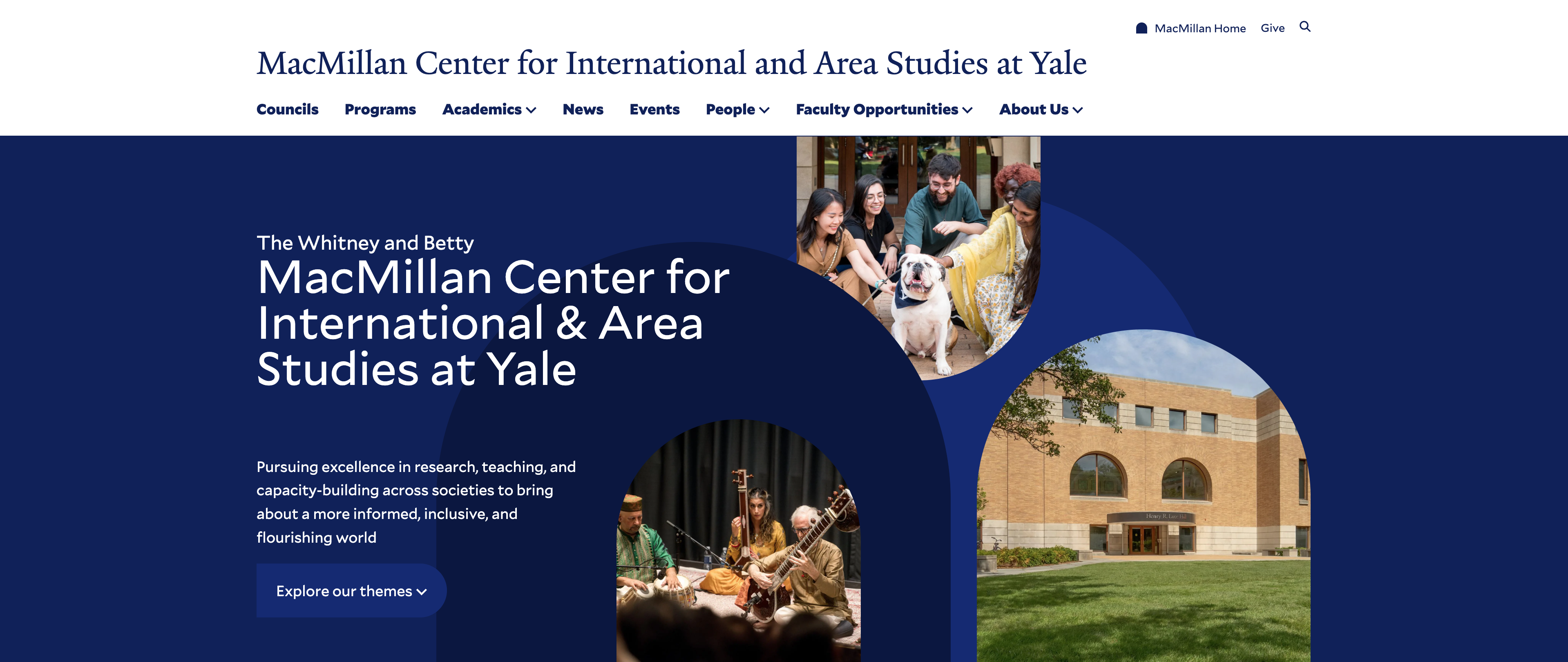
Inspired by the architectural features of their building, particularly the two arched windows at its entrance, MacMillan Center's communications team wanted this building feature reflected in their new digital design. With our decades of design experience we worked closely with the MacMillan Center to bring the concept of “windows on the world” to life. We developed a comprehensive design system that subtly incorporates these architectural curves, using them as a central theme throughout the digital experience.
All-encompassing Taxonomy
We built a taxonomy system to provide a structured way to connect related topics and ultimately improve the user experience. The system connects region-specific categories, thematic areas, academic programs, and institutional priorities. For instance, region-specific categories like East Asian Studies and themes like peace and development now tag all relevant programs and academic degree programs, independent courses, and the MacMillan Center's overarching priorities and values. By improving the visibility of the deeper content, the redesigned site creates a more intuitive user experience, encouraging visitors to explore various issues of interest to them.
Content Management System for the Content Manager
We optimized the Content Management System (CMS) to enable the MacMillan Center's many content editors to work faster and more efficiently. While not part of the original brief, we saw an opportunity to improve how the MacMillan Center created new sites and managed existing content. The result was a CMS that made it much easier for the Center's communications team to launch new programs. They can spin up a new program site in hours instead of days or weeks. We're proud to have created a scalable and affordable system that meets their diverse needs today and is ready to grow with them in the future.
Stakeholder Engagement
One of the most rewarding aspects of this project was the collaboration with the Center's diverse group of stakeholders. Nearly 100 individuals, including faculty, program leads, and staff provided input. Listening is just as crucial as creating, so we took the time to ensure every voice was heard. The input from these stakeholders was integral to the final design, and by building consensus, we created a shared vision that everyone felt part of. We take pride in this collaborative approach, strengthening the project and the relationships we build.
The Results
The redesign led to improvements in several key performance indicators (KPIs), including: